Key Stuck in Ignition: What to Try Right Now

Updated: Aug 13

A key stuck in the ignition is almost always fixable in under two minutes with the right sequence. Before you call anyone, confirm the gear selector is fully in Park, set the parking brake, and gently wiggle the steering wheel left and right while applying light, steady pressure to the key toward the OFF position. That combination resolves the majority of stuck-key situations on the spot.
Try these steps immediately, in order:
Confirm the engine is completely off
Press the brake pedal firmly and shift the selector through Neutral, then back firmly into Park
Wiggle the steering wheel left and right while easing the key toward OFF
Try your spare key if the primary key still won’t release
Check the dashboard for battery warning lights or a completely dark display
If the key begins to feel rough or binds, stop immediately
Pro Tip: Locksmiths see the steering-wheel wiggle fail most often when drivers apply too much rotational force on the key at the same time. Use the lightest possible key pressure while you wiggle the wheel, and let the locking pin drop on its own.
Key Takeaways
A key stuck in the ignition is almost always caused by a shifter off the Park detent, steering-wheel lock tension, or low battery voltage, and most incidents resolve with the mechanical checklist before any tools are needed.
Point | Details |
Try the checklist first | Shift firmly to Park, wiggle the steering wheel, and apply light key pressure before anything else. |
Battery voltage matters | A weak battery can trap the key by preventing the release solenoid from operating; jump-start before assuming a mechanical fault. |
Stop before you snap it | If the key feels rough or crunchy, stop immediately to avoid turning a simple fix into a cylinder replacement. |
Dry lubricant only | Use graphite or PTFE in the keyway every 6–12 months; avoid WD-40 and heavy oils that attract debris. |
Local Locksmith and Car Keys Delaware | Provides on-site extraction, ignition repair, and transponder programming throughout Delaware for situations the checklist can’t resolve. |
Table of Contents
What to do when your key is stuck in the ignition
Work through this ordered checklist before reaching for your phone. According to WikiHow’s ignition guide, these steps resolve most stuck-key situations without tools or professional help.
Engine off. Turn the ignition fully to OFF if it isn’t already. Some vehicles won’t release the key from the ACC or RUN position.
Brake pedal down. Press the brake pedal firmly. Many modern vehicles require brake input to release the shift-interlock circuit.
Shift firmly through Neutral and back to Park. A shifter that’s a millimeter off the Park detent can fool the interlock sensor. Cycling through Neutral and pressing firmly back into Park often resets it.
Set the parking brake. This removes any load on the drivetrain that might be holding the shifter off-detent.
Wiggle the steering wheel. Turn it gently left and right while applying light, steady pressure to the key toward OFF. The steering lock mechanism puts side-load on the ignition cylinder; centering the wheel releases that tension and lets the locking pin drop.
Check battery symptoms. If the dash is dim, the interior lights are weak, or the car won’t crank, a low battery may be preventing the electronic key-release solenoid from operating. Jump-start or charge the battery before trying again.
Try the spare key. A worn primary key can bind on cylinder wafers. A fresh spare often slides out cleanly.
Stop if you feel resistance. If the key feels rough, crunchy, or begins to bind under pressure, stop. Forcing it risks snapping the key or damaging the cylinder.
Safety rule: If none of these steps work within two or three calm attempts, call a professional. Repeated force is the fastest way to turn a $150 service call into a $400 cylinder replacement.
Why does your key get stuck? Common causes explained
Most stuck-key incidents trace back to one of six root causes. Knowing which one applies helps you pick the right fix immediately.
Carparts identifies the dominant causes as a shifter not fully in Park, steering-wheel lock tension, low battery voltage preventing the key-release solenoid, and wear or debris inside the cylinder.
Shifter not fully in Park (shift-interlock). The interlock circuit must see a confirmed Park signal before releasing the key. Even a hairline misalignment off the detent blocks that signal.
Steering-wheel lock tension. Parking with the wheels turned hard puts rotational load on the ignition cylinder. The locking pin can’t retract until that tension is relieved.
Weak or dead battery. Some vehicles use an electrically operated key-release actuator. Without adequate voltage, the solenoid stays closed and traps the key regardless of gear position.
Worn or damaged key. A key with bent teeth or worn cuts can catch on cylinder wafers, especially in older cylinders with accumulated wear.
Worn ignition cylinder. Years of use, grit, and moisture degrade the internal wafers. The key may enter and turn but bind on the way out.
Debris in the keyway. Pocket lint, sand, and small particles collect in the keyway and create friction that holds the key in place.
Failed range switch or brake-pedal switch. If the sensor that confirms Park or brake-pedal position is faulty, the interlock circuit never opens, even when the shifter is correctly positioned.
Cause | Most-Likely Quick Fix | When You Need a Pro |
Shifter off Park detent | Cycle through Neutral and back to Park firmly | Shifter won’t seat; cable or sensor fault |
Steering-wheel lock tension | Wiggle wheel while easing key to OFF | Cylinder feels gritty or crunchy |
Low battery | Jump-start or charge battery | No power after jump; solenoid fault |
Worn key | Try spare key | Spare also binds; cylinder worn |
Worn cylinder / debris | Graphite lubricant in keyway | Key only releases with excessive force |
Faulty range or brake switch | None safe for DIY | Persistent interlock failure |
Safe DIY fixes you can try at the roadside or at home
Before anything else, stabilize the vehicle. If you’re on a road or in a parking lot, turn on your hazard lights, confirm the parking brake is set, and make sure the car is in Park or Neutral.
Steering-wheel wiggle technique
Apply the lightest possible pressure to the key toward OFF while turning the steering wheel slowly left and right. You’re looking for the exact position where the wheel’s load on the locking pin drops to zero. When you find it, the key will turn freely. Don’t crank the wheel hard in one direction and hold it there — that increases the side-load rather than relieving it.
Cycling the shifter and using the shift-interlock override
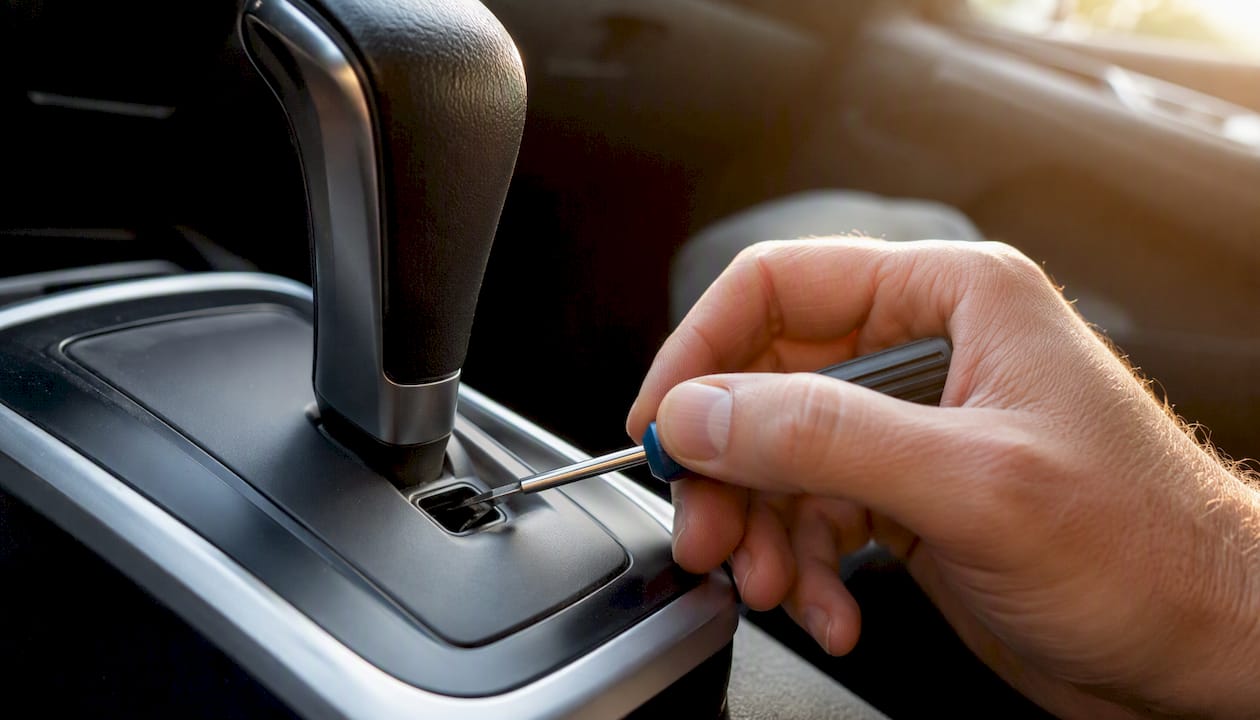
With the brake pedal depressed, move the selector firmly to Neutral, pause for a second, then press it firmly back into Park. Engineer Wala’s ignition guide notes that a hairline misalignment off the Park detent often prevents the interlock from registering Park, and this cycling motion commonly resets the circuit. If cycling doesn’t work, most vehicles have a manual shift-lock override slot near the shifter base, usually covered by a small plastic cap. Insert a flathead screwdriver or pen, press down, and shift to Neutral. Consult your owner’s manual for the exact location on your model.
Charging or jump-starting the battery
If the dash is dim or dead, connect jumper cables or a portable jump starter and let the battery charge for two to three minutes before trying the key again. CarParts.com confirms that low voltage can prevent the key-release solenoid from operating, and restoring voltage is often all it takes.
Lubricating the keyway
AutoZone recommends dry lubricants such as graphite powder or PTFE spray for ignition cylinders. Insert the straw applicator into the keyway, apply a small amount, then work the key in and out gently. Avoid WD-40 and heavy oils entirely. They attract dust and gum up the internal wafers over time, making the problem worse.
What not to do
Do not grip the key with pliers and pull. The torque will snap the key or strip the cylinder.
Do not use superglue to bond a broken fragment. It bonds to the cylinder walls and makes professional extraction far harder.
Do not force the key to turn if it feels rough or crunchy. That texture means wafers are misaligned or damaged.
Do not use WD-40 or any petroleum-based spray lubricant inside the keyway.
Pro Tip: If a portion of the key has snapped and the fragment is still visible above the keyway, fine tweezers or a thin pick can sometimes retrieve it. ASAP Locksmith Pros advises stopping immediately if the fragment is flush with the cylinder face, your tool bends, or the cylinder feels tightly bound. At that point, any further DIY attempt risks pushing the fragment deeper.
When should you stop and call a professional?
Some situations are beyond safe DIY territory. Call a locksmith or dealer when:
The key has snapped and the fragment is flush with or below the keyway face
The key feels rough or crunchy when turning, suggesting damaged wafers
The ignition cylinder feels gritty or stiff throughout its rotation
The key only releases under heavy force, even after all checklist steps
The car has no electrical power after a jump-start attempt
The vehicle won’t fully engage Park after cycling the shifter
The problem recurs repeatedly, which may indicate a recall-related shift-cable or column defect worth checking via your VIN at NHTSA.gov
What to expect from a professional service
A skilled locksmith or dealer technician can perform four main types of repair:
Broken-key extraction. Using extraction picks, hook picks, or a broken-key extractor tool to retrieve the fragment without removing the cylinder.
Ignition cylinder replacement. Removing the steering column collar, pulling the cylinder with a plug spanner or cylinder puller, and installing a new unit. The new cylinder is then rekeyed to your existing key where possible.
Transponder reprogramming. When a new key or cylinder is installed, the transponder chip must be programmed to the vehicle’s immobilizer. This requires dedicated programming equipment.
Electrical diagnostics. Testing the range switch, brake-pedal switch, and solenoid circuit to identify why the interlock isn’t releasing.
Typical costs for extraction or replacement vary by vehicle make and repair complexity, and can be higher depending on parts and labor involved. Factors that affect the final price include vehicle make and model, whether the car needs towing, and whether a new transponder key must be cut and programmed. Have your VIN, make, model, year, and a clear description of symptoms ready when you call — it helps the technician arrive with the right tools and parts.
What locksmiths actually do to fix a stuck or broken key
Understanding the professional process helps you know what to expect and why a trained technician can safely accomplish what DIY cannot.
Common professional tools: extraction picks, hook picks, broken-key extractor sets, plug spanners, cylinder pullers, ignition-collar removal tools, transponder cloning and programming devices, and bench rekeying equipment.
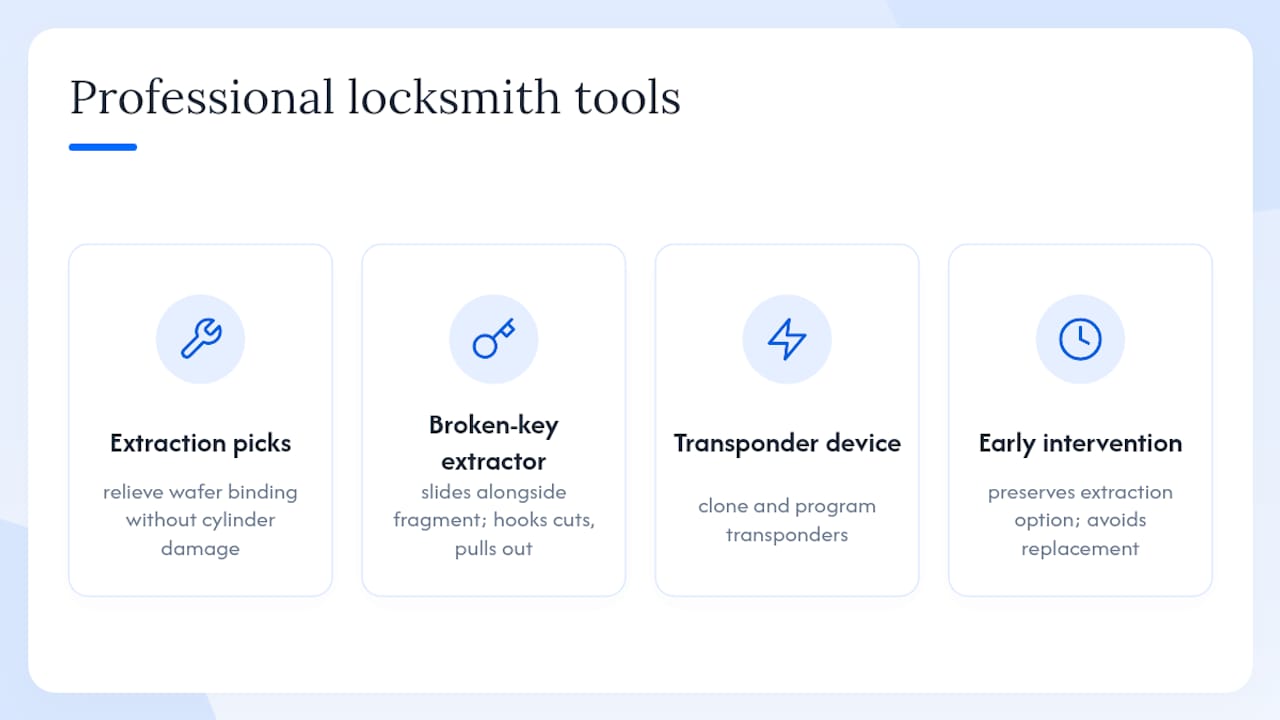
For a stuck but intact key, the technician first attempts the same mechanical steps you tried, but with calibrated tension and specialized picks to relieve wafer binding without damaging the cylinder. If the cylinder is worn, they may apply a professional-grade lubricant and work the key free before assessing whether replacement is warranted.
For a broken key fragment, the technician uses a broken-key extractor, a thin hooked tool that slides alongside the fragment and catches the key’s cuts to pull it straight out. This works reliably when the fragment has not been pushed deeper by prior DIY attempts.
Pro Tip: The single biggest factor in whether a cylinder survives a broken-key event is how quickly the owner stops trying to extract it themselves. Rick’s Free Auto Repair Advice notes that cylinders showing grit or wafer wear often need replacement regardless of extraction success, but early professional intervention preserves the option of extraction-only rather than full replacement.
Simple habits that keep your key from getting stuck again
Prevention takes less than five minutes a year and costs almost nothing.
Lighten your keychain. Heavy keychains put constant downward load on the ignition cylinder while you drive, accelerating wafer wear. Keep the ignition key on a separate ring or a minimal fob.
Lubricate the keyway every 6–12 months. A small amount of graphite powder or PTFE spray keeps the wafers moving freely and prevents debris from bonding to the cylinder walls. Rick’s Free Auto Repair Advice specifically recommends this cadence to reduce wear-related sticking.
Inspect your key for wear. If the cuts look rounded, the bow is bent, or the key feels loose in the cylinder, have a spare cut before the worn key fails entirely.
Keep the battery healthy. A battery that drops below 12 volts under load can trigger solenoid-related key trapping. Have the battery tested at any auto parts store if it’s more than three years old.
Clean the keyway with compressed air. A one-second burst of canned air every few months clears lint and grit before they compact into the cylinder.
Center the steering wheel before shutting off. Parking with the wheels straight prevents the steering lock from engaging under tension, which is the most common cause of the steering-wheel-wiggle problem.
Pro Tip: When you get a spare key cut, have it cut from the original manufacturer’s key blank rather than a copy of a copy. Each generation of cutting introduces small dimensional errors that compound over time and cause the key to bind in a worn cylinder.
A note from Local Locksmith and Car Keys Delaware
In our experience serving drivers across Delaware, the vast majority of stuck-key calls we receive come down to one of three things: a shifter that’s a fraction off the Park detent, a steering wheel locked under tension, or a battery that’s too weak to release the solenoid. Those three causes account for most of what we see on-site, and they’re almost always resolved quickly once a technician can confirm the root cause in person.
When the key has snapped or the cylinder feels gritty, the situation calls for professional tools. We carry extraction sets, cylinder pullers, and transponder programming equipment on every automotive call, so we arrive ready to handle the full range of outcomes rather than diagnosing first and returning later. Our service area covers Delaware, and we prioritize automotive locksmith calls for drivers who are stranded or in an unsafe location.
Local Locksmith and Car Keys Delaware is ready when you need on-site help
When the checklist hasn’t worked and the key is still stuck, the fastest path forward is a mobile locksmith who arrives with the right tools already loaded. Local Locksmith and Car Keys Delaware provides on-site automotive locksmith services throughout Delaware, covering broken-key extraction, ignition cylinder replacement, and transponder key programming in a single visit.

Before you call, have your VIN, vehicle make, model, year, and a brief description of what you’ve already tried. That information lets the technician confirm parts availability and arrive prepared. Our team handles the full process on-site, from extraction through programming, so you’re not left waiting for a second appointment. To see the complete range of locksmith services we offer or to reach us directly, visit our website or call now for a fast, transparent quote.
Sources
Recommended


Comments